|
KLS SC90
PROFESSIONAL DEVELOPMENT
FIELD
TRIP
"Iberian Pyrite Belt: VMS Geology and Mineralization"
With Dr. William X. Chavez, Jr.
and Dr. João Matos
Seville and
Southern, SPAIN
November
15 (Sunday evening) to November 21 (Saturday morning), 2026 (5
full
days + 2 partial days)
|

 |


|
Introduction
The Iberian Pyrite Belt (IBP) is host to some of the world's largest VMS
deposits and mines such as Aguas Tenidas (MATSA)
and Rio Tinto (Atalaya Mining). It represents the largest concentration of
massive sulphide deposits in the world, forming an arch through Portugal
and Spain about 250 km long and 30-50 km wide and has produced more than
1,750 million tonnes or massive sulphide ore and 2,500 million tonnes of
mineralized stockwork over the past hundred years.
This intensive,
5 full-day and 2 partial-day field trip will begin in Lisbon/Lisboa on the evening
of
Sunday, November 15th
and end in the morning on Saturday morning, November 21st, 2026.
There will be eight main deposit visits:
1. Peña de Hierro deposit -
Abandoned pyrite (+ Cu) massive sulphide mine. The mine was opened in
the middle of the 19th century and closed in 1966.
2.
San Miguel deposit - Closed and inactive Volcanogenic massive sulphide
mineral deposit
3.
Odiel classic river section - volcanic and acid mine water runs through
the heavily mined Iberian Pyrite Belt
4.
Aguas Tenidas Mine
- an underground massive sulphide deposit
5.
Magdelena Mine - an underground copper and polymetallic mine
6. Tharsis deposit - a giant volcanogenic massive sulfide (VMS) mining
district
7. La Zarza deposit - a world-class volcanogenic massive
sulfide (VMS) deposit
8. Los Frailes deposit - a major polymetallic
massive sulphide mining project

(Credit: Avrupa Minerals PDAC 2017 presentation)
Course Format and Delivery
Summary:
Day 1. Sunday Nov 15:
Check-in starting at 3pm and Welcome dinner at 7pm. In Seville.
Day 2. Monday Nov 16: Full day lecture
with Dr.
Chavez and Mr. Matos. In Seville.
Day 3. Tuesday Nov 17:
Peña de Hierro deposit,
San
Miguel deposit ,
Odiel classic river section. Stay in Aracena.
Day 4. Wednesday Nov 18:
Aguas Tenidas Mine
and
Magdelena Mine. Stay in Aracena.
Day 5. Thursday Nov 19:
Tharsis deposit, La Zarza deposit, Los Frailles deposit. Stay in
Seville.
Day 6. Friday Nov 20: Full
day lecture with Dr. Chavez and Mr. Matos. Stay in Seville.
Day 7: Saturday Nov 21: Short Q & A wrap up and
goodbyes, end by 10am
The
field
trip will be led by
Dr.
William Chavez
with geological assistance from
Mr. João Matos
and will run for 2 partial days and
5
full
days in Southern Portugal. Instruction will be
in the
classroom some days and in the
field
other days
and in English.
With some explanations in
Spanish and Portuguese possible.
Most outcrops are accessible via
the mines or
roads or
short traverses on foot.
Day 1 evening, Sunday, Nov 15: Starting
from 3pm, check-in to the hotel in Lisbon/Lisboa. There
will be a
group welcome dinner at 7pm.
Overnight in
Seville.


Day 2 (Field day 1): Monday, Nov 16: We will start with
breakfast. Then a full day presentation about the days ahead and
the
history, geology, metallogeny, and potential of the Iberian Pyrite Belt.
Lunch at the hotel. Dinner and lodging in Seville.
Day 3 (Field day 2): Tuesday Nov 17:
We will start with an early breakfast. Travel ~1.5 hours to
the Peña de Hierro deposit,
San
Miguel deposit ,
and
the Odiel classic river section. Lunch in the field.
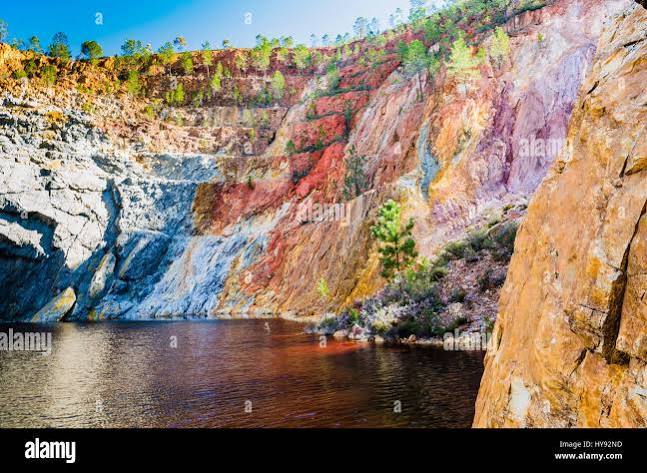
Peña de Hierro deposit (Rock of Iron): Mining activity
at the site dates back to pre-Roman times and the Roman era. Systematic
modern extraction began in the 19th century (around 1853), later
operated extensively by British and Spanish companies. Utilized both
underground mining (including a 155-meter deep shaft) and open-cast
mining methods to extract pyrite and copper. The site is part of the
Riotinto Mining Park,
featuring guided tours of the subterranean galleries, open pits, and a
visitor center.
It is derived from its massive
gossan cap. Over millions of years, atmospheric oxygen and water heavily weathered
the shallow sulfide minerals. This dissolved away the sulfur and base
metals, leaving behind a thick, rust-colored crust dominated by iron
oxides and hydroxides (like hematite and goethite). Ancient miners
originally targeted this iron cap because it naturally concentrated gold
and silver

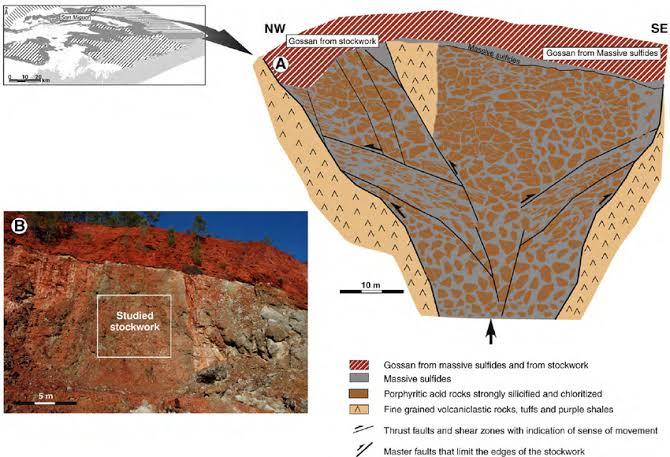
San Miguel deposit: is
another classic volcanogenic massive sulfide (VMS) deposit within the
Northern Zone of the Iberian Pyrite Belt.
While it shares the same overarching geological history as Peña de
Hierro, it exhibits unique structural and mineralogical
characteristics that make it a textbook geological showcase. Unlike
shale-hosted deposits in the southern part of the belt, San Miguel is
celebrated as the
best outcrop example in the Pyrite Belt of a stockwork and massive
sulfides directly replacing volcanic rocks. Unlike shale-hosted deposits
in the southern part of the belt, San Miguel is celebrated as the best
outcrop example in the Pyrite Belt of a stockwork and massive sulfides
directly replacing volcanic rocks.
Dominated by a dense matrix of
pyrite,
with highly irregular concentrations of chalcopyrite (copper),
sphalerite (zinc), and galena (lead). During its
primary modern operation period (1851–1960),
the
mine
produced roughly
1.29 million tons of ore,
averaging
46% Sulfur
(highly prized for sulfuric acid production) and
2–3% Copper.
Like Peña de Hierro, the surface of San Miguel features one of the most
structurally spectacular
gossan caps (monteras de hierro)
in
Spain. Because copper content naturally concentrated and increased
drastically in the supergene (secondary enrichment) zone just beneath
this iron cap, it was heavily targeted by Roman miners. The stark,
deeply rusted iron-oxide coloration is still a prominent visual landmark
at the abandoned open-pit site today.

Odiel classic river section: The
(Río
Odiel),
running parallel to the Rio Tinto through the Iberian Pyrite Belt,
features spectacular geological and environmental river profiles heavily
shaped by Acid Mine Drainage.
Unlike the uniformly blood-red Río Tinto, sections of the Odiel shift
dynamically from deep crimson to vibrant
ochre, yellow, and greenish-milky hues.
This variation is caused by complex pH changes that precipitate
different mineral compounds (like jarosite and schwertmannite) along its
path.
The river section winds through abandoned 19th-century watermills (Molinos
del Odiel),
ancient stone bridges, and mining terrace walls that sit directly in the
acidic path.

Drive ~30 mins to Aracena.
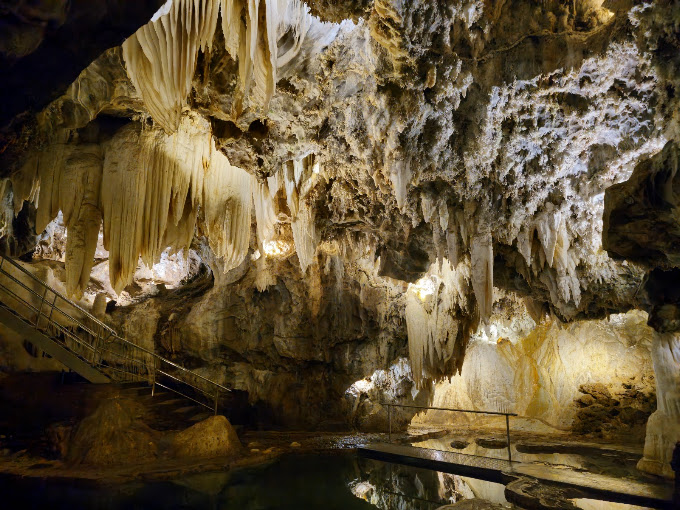
Short tour to
Gruta de las Maravillas
(Cave of Wonders) in Aracena, if it is open.
It is
a stunning underground karstic cavern featuring crystal-clear
subterranean lakes, colorful stalactites, and towering columns.

Check-in to the hotel.
Dinner in Aracena. Overnight in Aracena.
Day 4. Field day 3:4. Field day 3:
Wednesday Nov 18:
Early breakfast. Drive
~30 mins to
Aguas
Tenidas Mine
and
Magdelena Mines operated by Sandfire MATSA.
Security and Safety checks.
Company geology presentation, drill core examination and on-site geology
tour.
Dinner in Aracena. Lodging in Aracena.
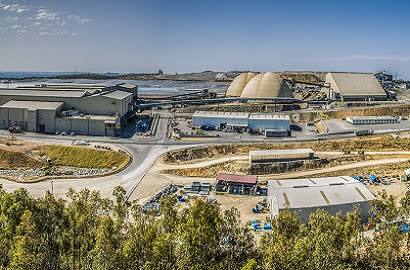
The
Aguas Teñidas Mine
and
Magdalena Mine
are
two highly sophisticated, active underground mining operations located
in the Almonaster la Real municipality of Huelva, Spain.
They form the backbone of the
MATSA (Minas de Aguas Teñidas SA) mining complex,
which is 100% owned and operated by the Australian mining firm
Sandfire Resources.
Unlike historic open-cast pits like Peña de
Hierro or San Miguel, these are modern, high-tech,
fully underground polymetallic operations.
Mineralization is bound to
four large tabular, lens-shaped ore bodies.
The main ore bodies are located deep underground, plunging between
270 to 890 metres below the surface,
and stretch over a 3,000-metre strike length.
While polymetallic, its main economic reserve and driver is
copper ore.

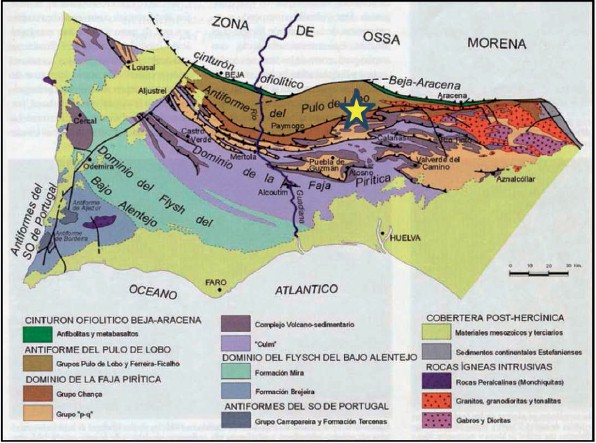
Ángel Granda Sanz, et al., 2019. El descubrimiento del Yacimiento de la
Magdalena... Boletín Geológico y Minero, 130 (2): 213-230
Figure 1.
Location of the Magdalena deposits in the Iberian Pyrite Belt.
Lunch will be on-site.
Drive ~30 mins to Aracena hotel.
Dinner in Aracena. Overnight in Aracena.
Day 5. Field day 4: Thursday Nov
19: Early breakfast. Drive ~ 1 hour to
Tharsis deposit,
La Zarza deposit and Los Frailles deposit.
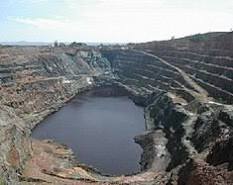
Tharsis deposit:
a
giant volcanogenic massive sulfide (VMS) and shale-hosted ore system in
the Iberian Pyrite Belt
with a mining history spanning over 5,000 years. Rests on a deep
Devonian Phyllite-Quartzite base group, overlain by a Carboniferous
volcano-sedimentary complex containing shales, felsic volcanic rocks,
and massive sulfide lenses. Originally held over 133 million tonnes of
ore across multiple lenses (such as Filón Norte), dominated by
fine-grained pyrite with high sulfur grades, plus zinc, lead, copper,
and accessory gold. The massive sulfide system overlies a
volcanic-sedimentary succession of Visean (Carboniferous) age. It sits
in the northern sector of the belt, characterized by pull-apart fault
basins.
La Zarza deposit: Closely linked
historically and operationally to the neighboring Tharsis systems, it
represents a massive concentration of metal-rich crude pyrite. Similar
to Tharsis, mining footprints at La Zarza trace back to the Bronze Age
(circa 1500 BC). The Roman Empire heavily operated the site between 100
AD and 300 AD, targeting precious metals like silver. Unlike typical VMS
deposits where lead and zinc settle at the top, La Zarza showcases an
inverted metal distribution. Finely bedded, polymetallic lead-zinc
(Pb-Zn) ores are found in the
lower zones of the deposit. This layer is
blanketed by a massive, uniform pyrite facies accounting for 90% of the
orebody. Copper (Cu) behaves independently, concentrating heavily within
basal stockwork veining and breccias.
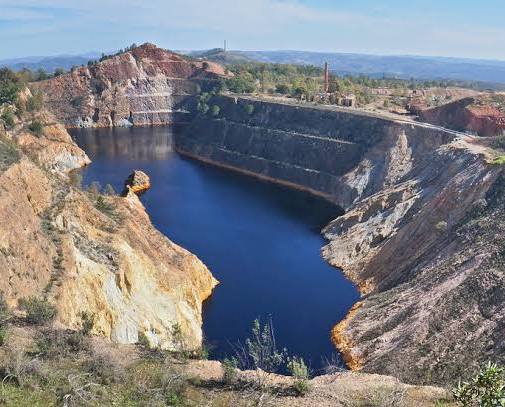
Los Frailes deposit: is another
massive volcanogenic massive sulfide (VMS) deposit within the
Iberian Pyrite Belt. It is infamous for the
1998 Aznalcóllar disaster,
which triggered one of Europe's worst environmental catastrophes when a
tailings dam collapsed. Like Tharsis and La Zarza, Los Frailes formed
over 350 million years ago during the Carboniferous period on an ancient
volcanic seafloor. The deposit is highly polymetallic. It
originally boasted a reserve of over
70 million tonnes
of ore rich in
zinc, lead, and copper,
along with significant accessory silver and gold. The orebody consists
of a massive stratiform sulfide lens
underlain by stockwork feeder veins, embedded tightly within a sequence
of dark, organic-rich shales and felsic tuffs.

Lunch will beLunch will be
in the field.
In the late afternoon, we will travel ~45 mins to
Seville. Dinner and lodging in Seville.
Day 6. Field day 5: Friday Nov 20:
We will start with breakfast. Then a full day presentation about the
past 4 days and the further studies about the
geology and
metallogeny
of the Spanish Iberian Pyrite Belt. Lunch at the hotel. Dinner and lodging
in Seville.
Day 7 Saturday morning, Nov 21: Breakfast. Wrap-up short
Q & A and presentation. Thank yous and good-byes. Finished by 10am.
Who should attend: This course is intended for geologists engaged in,
or interested in, regional- or
deposit-scale mapping or in drilling programs in volcanic
massive sulphide (VMS) deposits for the
purpose of mineral exploration. No prior
VMS
geology
training
is required.
The course is presented and taught in English. With some help in
Spanish or Portuguese as needed.
 |
Dr. William X. Chávez, Jr.
is a Professor of Geological
Engineering and Economic Geologist at the New México School of
Mines, since 1985.
He received B.Sc. degrees in Geology (1977) and
Mine Engineering (1977) from the New México School of Mines; he
has M.A. (1980) and Ph.D. (1984) degrees in Geology from the
University of California at Berkeley.
He
is fluent in English and Spanish.
Bill
is a renowned leader of international field trips and an expert
mapping instructor. He has inspired decades of students who have
risen to prominence, or at least unsung but crucial
participation, in discoveries all over the world. Bill has a
special affinity for supergene alteration processes and products
and is one of the few humans on earth who can tell you the
difference between atacamite and brochantite with the naked eye,
and then explain why the difference is important. Going from
micro mineralogy to phase diagrams to outcrop to regional
tectonic context, Bill tells a holistic story of ore genesis and
relates it back to economics in a singular and inimitable style.
We can
all expect a lively, thought provoking, and
stimulating trip. |
 |
Dr.
João Xavier Matos.
Assistant Researcher,
LNEG – Mineral Resources
and Geophysics Unit, Aljustrel Drill Core Library |
$5,597 CAD early
registration (to October 15, 2026) | $5,897 CAD late registration (after
October 15, 2026)
(Approximately $3,970 USD for the
early price & $4,185 USD for the late price)
Fee includes: Five (5) full days and two (2)
half days of instruction,
6
nights
double-occupancy lodging (November 15 to 21), all meals, wine tour, ground transportation to field
sites, fuel, permits,
tuition fees, field deposit and mine fees, guidebook with pre-selected relevant papers,
and
participation certificate.
Space is limited for all Courses. Register
early to avoid disappointment.
KLS Geological reserves the right to cancel
Short Courses that do not meet minimum attendance requirements by the
early fee date.
Minimum of 14 participants required by the early
registration date
Maximum of 20 participants overall
Payments accepted by cheque, wire and bank
transfers, and all major credit cards
Register here by filling in the
attached registration form, and sending it back by email,
fax or by mail
As well, there are
Sponsorship and advertising opportunities.
Please contact Karie Smith at
karie@klsgeo.com for more information....
|
